
Is Asbestos Air Testing Worth It Before Buying a House?: What Buyers Should Know
Last Updated: November 19, 2026
Quick Summary
Asbestos air testing is usually not the best first step when buying an older house, because it only measures fibers airborne at the time of sampling. It is most useful when materials are already damaged or disturbed, or when current exposure is a concern. For a full picture of what the building contains, material sampling or a full inspection is typically more informative.
Air testing measures airborne fiber concentration over a set period, not whether asbestos is in walls or floors.
A clean air result can create false reassurance if buyers assume the house is asbestos-free.
Material sampling identifies which specific materials contain asbestos and where they are located.
Homes built before the mid-1980s deserve closer attention, especially if renovation is planned.
Schedule inspections during the contingency period so findings can be acted on before closing.
Is your Long Island home safe to buy?
Asbestos Buster provides clear, accurate asbestos testing and reporting for Nassau County properties.
Table of Contents
Why Asbestos Matters When You Are Buying an Older House
Asbestos is a fibrous mineral that was widely used in American homes and buildings for decades, particularly before the late 1980s. Many buyers of older houses do not realize how common it was in insulation, flooring, pipe wrap, and roofing products.
The central question is simple: does the risk justify the cost and time of testing before you commit? Asbestos-containing materials that are intact and undisturbed generally pose a lower risk than damaged or deteriorating ones (the EPA). The EPA guidance on asbestos in the home explains that fibers are released mainly when materials are damaged or disturbed.
Older homes built before the mid-1980s deserve closer attention. Renovation plans change the picture entirely, because cutting, drilling, or demolition can release fibers that were previously contained.
What Asbestos Air Testing Actually Measures
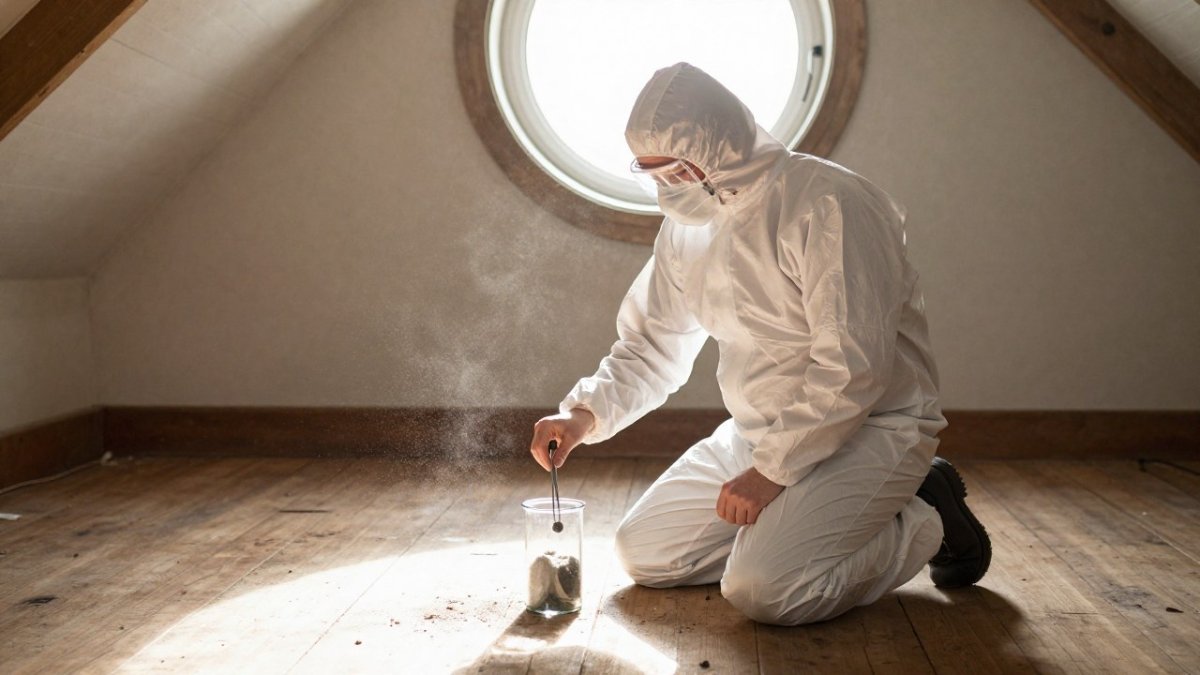
Asbestos air testing measures the concentration of airborne asbestos fibers in a sample of air over a set period.
Air testing does not tell you whether asbestos is present in a wall, floor, or ceiling. It only reflects what is currently airborne.
This limitation matters during a home purchase. A clean air result can create false reassurance if the buyer assumes the house is free of asbestos.
Air Testing Versus Material Sampling: Which Answers Your Question
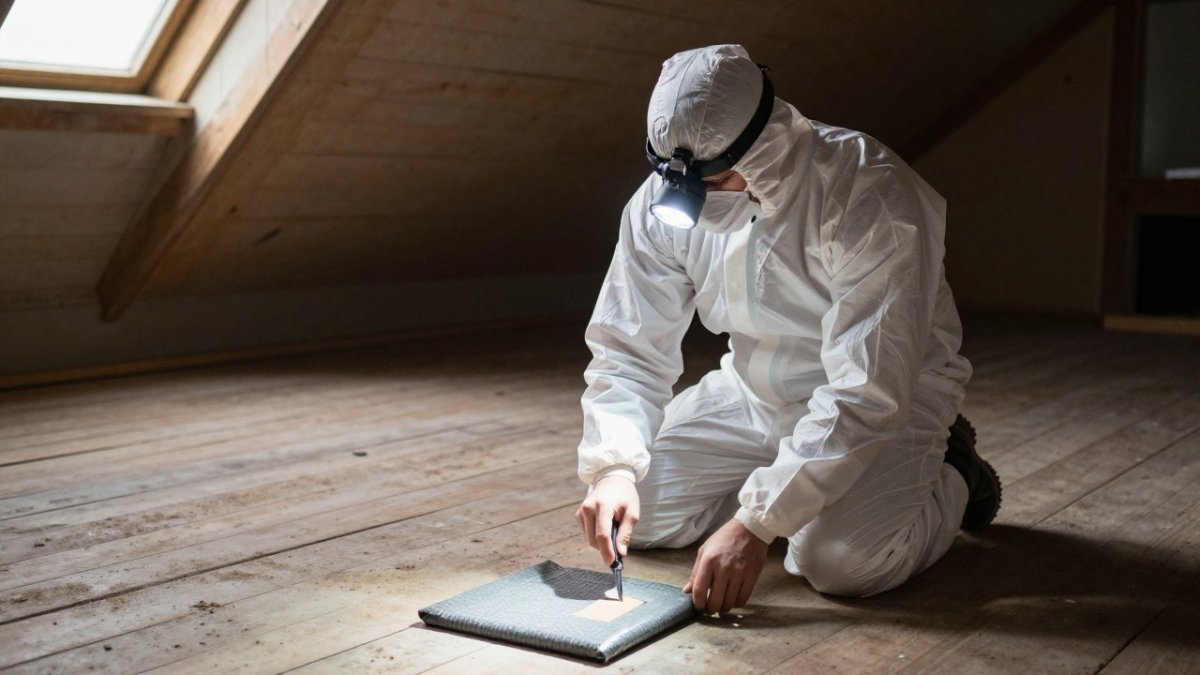
Air testing and material sampling answer different questions. Material sampling involves collecting small pieces of suspect materials and sending them to a lab for analysis. It identifies whether asbestos is in the building, and where.
Most buyers who want to know what is in the house need material sampling, not air testing alone. Air testing becomes useful when materials are already disturbed, when there is visible damage, or when you want to know whether current conditions expose occupants to fibers.
Comparison of Air Testing and Material Sampling
Factor | Air Testing | Material Sampling |
Question answered | Are fibers airborne now? | Is asbestos present in this material? |
Method | Pumped air through a filter | Small physical samples sent to a lab |
Typical use | Damaged materials, post-disturbance checks | Pre-purchase and pre-renovation surveys |
Limitation | Misses hidden or undisturbed materials | Does not show current airborne levels |
Best for buyers | Confirming current exposure | Identifying which materials need attention |
Asbestos Inspection During a Home Purchase: Timing and Limits
Timing matters in a real estate transaction. A pre-purchase inspection done early leaves room to negotiate repairs, adjust the price, or walk away. Learn what asbestos inspections involve and when to schedule one.

Inspections have limits. A visual inspector cannot see inside walls or behind finished surfaces without invasive sampling. A single visit cannot guarantee that every hidden material has been identified.
Testing on the seller's side does not always transfer to the buyer. Ask whether prior results cover the areas you plan to alter.
Asbestos Air Quality Test Cost and What It Is Worth
Air testing is often not the most informative choice for a buyer who has not yet identified suspect materials. Understanding what each testing dollar buys is the fastest way to decide whether air monitoring belongs in your contingency period at all.
What drives the price of an air test
Costs for asbestos air monitoring depend on the scope of sampling. Costs can rise with:
Number of sampling locations. A single baseline sample in a basement is one price; sampling each floor, the HVAC return, and the attic is several times that.
Sampling method. Phase contrast microscopy (PCM) is the standard, lower-cost method used for clearance and worker-protection monitoring, but it counts all fibers, not just asbestos. Transmission electron microscopy (TEM) or scanning electron microscopy (SEM) can confirm asbestos fiber types and costs materially more per sample.
Turnaround time. Rush and faster results may carry a premium that matters when your inspection contingency is ticking.
Pricing depends on the number of samples, the locations tested, the method used, and turnaround time. For current prices, contact Asbestos Buster directly for a written quote that itemizes the scope rather than accepting a single bundled number.
Air testing versus bulk sampling versus a full survey
These are three different products at three different price points, and buyers often conflate them:
Service | What it tells you | Typical relative cost | Best used when |
Air monitoring (PCM) | Airborne fiber concentration at the sampled point and time | Lowest per sample, but adds up with locations | Materials are already damaged, or you want a post-abatement or post-disturbance check |
Bulk material sampling | Whether a specific suspect material contains asbestos | Moderate; priced per material sampled | You have identified suspect materials and need to know which contain asbestos |
Full asbestos survey / inspection | Inventory of suspect materials, condition, and sampling plan | Highest, but most comprehensive | Pre-purchase or pre-renovation, especially in pre-1980s homes |
For many buyers, a survey or targeted bulk sampling may be a more useful starting point than air testing. Air testing answers a narrow question, what is airborne right now, and a low reading can be falsely reassuring if the materials that could release fibers later are still in place. Air testing earns its cost when there is a specific reason to believe fibers are currently being released: visible damage, recent disturbance, a failed prior abatement, or a renovation already underway.
A simple decision framework
Use the home's age, condition, and your plans to decide which test to buy:
Built after the late 1980s, no suspect materials, no renovation plans. Testing is usually not worth the cost; document the age and move on.
Pre-1980s home, materials intact, no renovation plans. Targeted bulk sampling of any suspect materials you or the inspector can see is usually the better buy than air testing.
Pre-1980s home with damaged, crumbling, or water-damaged suspect materials. Air testing plus bulk sampling is reasonable, because you have both a current-exposure question and an inventory question.
Weigh the testing cost against the price of the home and the renovation budget, but also against the cost of discovering a removal problem after closing. A targeted sampling scope is usually far less expensive than emergency abatement, and it produces the inventory you need to negotiate.
Ask what the report will actually tell you before you approve any scope.
Buying a House with Asbestos: How to Interpret Results and Next Steps
A lab report is only useful if you can read it. Learn how to read fiber counts, units, and clearance levels in your lab report. Air results and bulk-sample results are formatted differently and mean different things, and the next step depends on which one you are holding.
Reading an air-monitoring report
Air results are reported as a fiber concentration, typically fibers per cubic centimeter (f/cc) or structures per cubic centimeter (s/cc), along with the analytical method (PCM, TEM, or SEM) and the sampling time and volume. Key points to check:
Method matters. PCM counts all fibers of a certain size, not just asbestos. A PCM result above the laboratory's reporting limit does not by itself prove asbestos is present; TEM or SEM can identify fiber type.
There is no universal 'safe' residential number. Regulatory thresholds exist for workplaces and abatement clearance, not for a pre-purchase home inspection, so a number that looks low on a report may still warrant a professional's interpretation given the home's materials and condition.
A single sample is a snapshot. Air concentrations vary with activity, HVAC operation, weather, and where the pump sat. One low reading does not prove the house is fiber-free, and one elevated reading does not prove a crisis, it proves you need a plan.
Reading a bulk-sample report
Bulk reports list each sampled material, the location it came from, the analytical method (commonly polarized light microscopy, PLM), and a result of asbestos detected or not detected, often with a percentage and fiber type. Pay attention to which materials were sampled and which were not, a report that clears the floor tile says nothing about the pipe insulation in the basement.
What to do with each kind of result
Asbestos detected in intact, undisturbed material. Management in place is often the reasonable path: leave it alone, label or note it, avoid drilling or cutting, and monitor condition over time. This is frequently preferable to removal, which itself creates exposure risk if done poorly.
Asbestos detected in damaged or deteriorating material. Limit access to the area, avoid disturbing it, and get a licensed abatement professional to assess. Removal or encapsulation may be warranted.
Asbestos detected in material you plan to renovate. Plan abatement or specialized removal into the renovation scope and budget before work begins; do not let a general contractor cut into it.
Who to call and what to keep
For removal or significant disturbance, use a licensed abatement contractor and confirm how waste will be handled under applicable rules. For interpretation, an accredited inspector or industrial hygienist can translate the report into a scope of work.
Watch out: treating a clean air result as proof the house is asbestos-free is the most common interpretation error buyers make, it answers only what was airborne at that moment, not what is sealed in the walls.
Booking an Asbestos Inspection Before You Sign: Your Next Step
If you are weighing whether to test before buying, start by reviewing the seller's disclosures and identifying the materials and renovation plans that matter most to you. Asbestos Buster offers professional asbestos testing services including bulk, air, and specialized sampling for properties across Nassau County and Long Island.
Contact Asbestos Buster to request a quote and schedule an inspection while your contingency window is open. Early action gives you the most options.
Frequently Asked Questions
Should you test for asbestos before buying a house?
Testing is worth considering if the house was built before the mid-1980s, when asbestos-containing materials were still common in US construction, and if you plan renovations that would disturb walls, flooring, ceilings, or pipe insulation. An intact, undisturbed material may not release fibers, so many buyers start with a visual inspection and a material survey. If the survey finds suspect materials that you intend to disturb, air testing or targeted sampling becomes more useful. Ask the inspector to explain which tests they recommend and why before you commit to any particular scope.
Is asbestos air testing useful if asbestos-containing materials are undisturbed?
Air testing measures airborne fibers at the time of sampling, so it can show whether fibers are being released under normal conditions. Intact materials that are not being disturbed often produce low airborne readings, but a single test cannot guarantee that fibers will not be released later. Air testing is most useful when materials are damaged or when work is planned that would disturb them. A negative air result also does not prove that no asbestos is present in the building, so it should be interpreted alongside a material survey and the home's age and condition.
What is the difference between asbestos air testing and material sampling?
Air testing collects samples of the air to check for airborne asbestos fibers, usually by drawing air through a filter for a set period. Material sampling involves collecting small pieces of suspect building materials, such as floor tiles, insulation, or joint compound, and sending them to an accredited laboratory for analysis. Material sampling answers whether a product contains asbestos, while air testing answers whether fibers are present in the air at that moment. Most buyers need material sampling first, and air testing is added when there is disturbance or damage to consider.
How much does an asbestos air quality test cost?
Pricing depends on the number of samples, the size of the property, the scope of the work, and whether the test is done alone or as part of a larger inspection. For current pricing and a quote tailored to your property, please contact Asbestos Buster directly through its website. When comparing quotes, confirm whether the price includes sample analysis, a written report, and any follow-up recommendations. Ask for the scope in writing so you can compare providers on equal terms.
Comments